
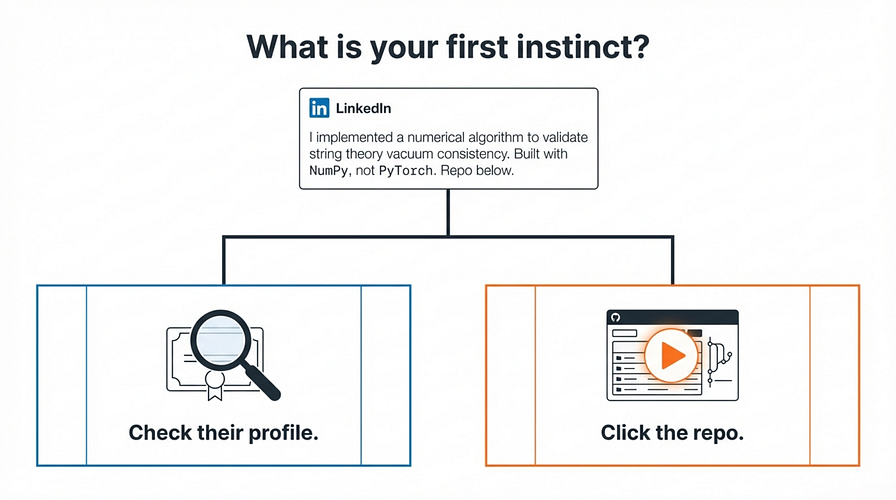
Someone posts this on LinkedIn:
“I implemented a numerical algorithm to validate string theory vacuum consistency. Built with NumPy, not PyTorch. Repo below.”
What do you do first?
A) Open their profile. University, publications, credentials.
B) Click the repo. Read the README. Try to run it.
C) Scroll past.
C means you’re not in this field. Fine.
But if you work in AI, you chose A or B. That instinct reveals more about where this industry is cracking than any benchmark announcement in 2026.
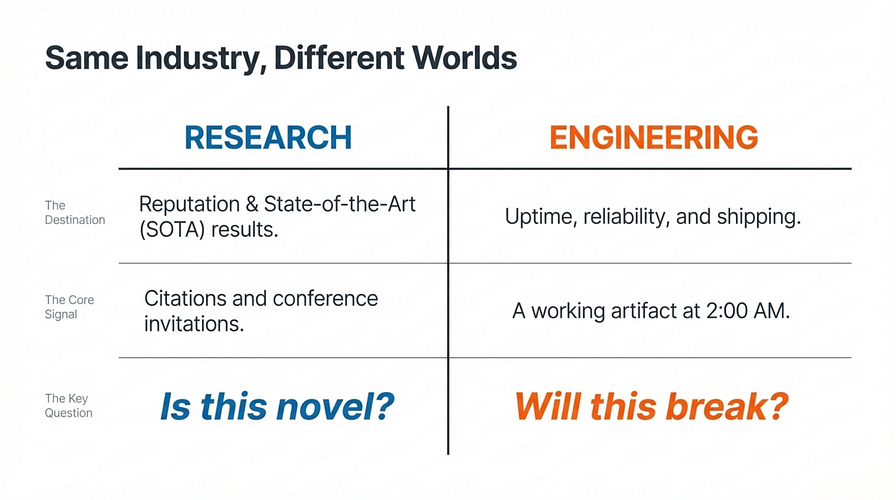
If you chose A, you are probably operating inside a world where that instinct makes sense. That’s not a criticism — it’s the logic of the job.
A researcher’s destination is reputation. Citations, SOTA results, conference invitations. Checking credentials is rational in that world. A paper from an unknown author with no affiliation is genuinely harder to evaluate. The system makes sense, inside that world.
An engineer’s destination is something that runs. Ships. Doesn’t break at 2am. The only signal that matters is the working artifact. That system makes sense, inside a different world.
Neither instinct is wrong. The problem is that both worlds now use the same words for different things.
I’ve built enough systems that looked correct in testing and failed in production to know the difference. A result that doesn’t survive real conditions isn’t a result. It’s a failure with good cosmetics. That understanding changes how you read a repo. It changes which questions you even think to ask.